
DISCOVER THE HAVELI OF TALES
DISCOVER THE HAVELI OF TALES
Holi is the celebration of spontaneity. We owe our joys to the Holi and our Holi to the divine playfulness of Krishna. The Ragas (our music, resonances), Rang (colors, involvement) and Rasa (subliminal pleasures, nectar) are the outcomes. There may be a thousand ways to celebrate Holi in India but Holi has only one colour and that is the colour of an inclusive spirit.
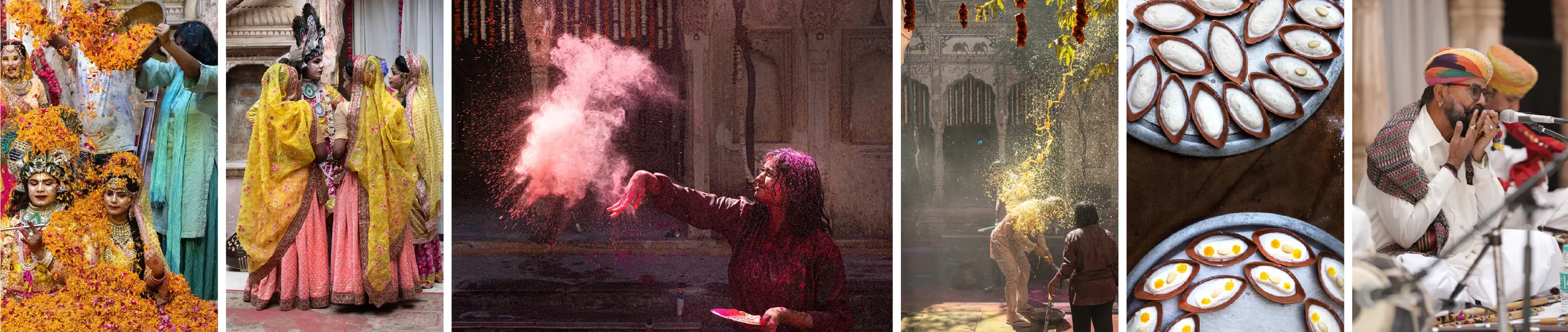
Whether inside the Haveli or travelling around the Haveli, there is one common expression of Holi, the expression of colours. It is so well-entrenched in us to celebrate this season, that we celebrate colour everywhere, in temples, streets, community parks, private events, in every possible human gathering in much of India.
As well as colour, this is also the time to celebrate with music. It’s time for people to dance in the open. All around the Haveli, the region of Shekhawati is famous for Geendad - a group dance to the beat of the drum and the lightness of the f lute. This happens for several nights preceding the day of Holi, and here at the Haveli we like to stage performances of folk singers and classical musicians of the region - there is a huge repertoire of Holi Festival specific folk and Bhakti songs.
Holi is the Festival of Food, so elaborate cooking sessions happen daily. Thandai, an aromatic, spiced drink is prepared in the traditional way and served throughout the festival. Rare delicacies involving ingredients like desiccated coconut, fennel seeds, fresh raw mangoes, rose petals, gulkand, kewra, mishri, chironji and makhana are made each day.
For visiting our organic farm and seeing the harvests, these days are perfect - warm and pleasant. Almost all the trees and bushes now bear fresh leaves and flowers. You’ll see the striking visual impact of our Indian native trees - Semal (Indian cotton silk tree) and Palash (Flame of the forest tree).
India embraces all these celebrations of life during Holi. Artists, poets, musicians and people from all walks of life will never tire of paying tributes to this phenomenon in their own ways. Only the learned will decipher if it’s a festival. We call it Holi.
We call it Holi.
MARCH 13: Welcome ceremonies. Wedding band performances and Shekhawati Holi songs. Meet the Shekhawati veterans for interpreted storytelling in the adjacent Ram Temple.
MARCH 14: Rajasthani food festival. Private Shekhawati geendad singing by local performers in the Ruined Courtyard.
MARCH 15: Meet the Manganiyar singers for tracing the Western Rajasthani heritage of temple and wedding singing.
MARCH 16: Rajasthani food festival in picnic feast. Manganiyar singing performance in the Thar Desert Farm.
MARCH 17: Holi food preparations. Meet the Kalbeliya gypsy artists with the session on their adapted lifestyle to Indian Thar desert.
MARCH 18: Heritage walk in the town. Kalbeliya dance evening in the Khandahar Chowk.
MARCH 19: Holi dessert preparation with traditional sweet makers of Rajasthan in the Gai chowk. Fragrance offering with Holi playing in the main temple. Heavy decoration of the haveli with the fragrant flowers of Spring. A public classical music concert.
MARCH 20: Grand feasting day in the Haveli. Concert by maestros in Khandahar Chowk in the late morning. Late afternoon grand Raas Leela in Khandahar Chowk with Krishna inspired dances. Holi colour is embraced in the evening with everybody throwing fresh flower petals followed by a special buffet dinner in the Holi Chowk.
MARCH 21: The Khandahar Chowk will be thrown open for dancing & celebration for the residents. There also be a visit to the town for Holika burning ceremony and Geendad dance
MARCH 22: A wild Holi day in the Holi Chowk for everyone to participate in the play of coloured powders and water. Enthralling phaag singing ceremony in the Gopinath Ji temple premises in the evening and the residents of Haveli will be welcome to join.
MARCH 23: Departure of guests begins.
Compulsory duration, minimum 4 nights.
